
Types of Assessment

In this lesson, we will explore the different types of assessment in CLIL—summative, formative, peer, self, portfolio, and performance-based assessment—while linking each one to practical ESL classroom examples. You will also see how assessment criteria, grading, and feedback work in real classrooms.
In a CLIL classroom, teachers face a unique challenge: they are not only teaching subject content but also helping learners develop their second language skills. Because of this dual focus, types of assessment in CLIL cannot look the same as in traditional subject classrooms or in pure language classrooms. Instead, CLIL requires an approach that balances both content and language.
Assessment tells us how much our learners have understood, how well they can use the subject language, and what progress they are making. But it is also a tool for shaping learning. When done thoughtfully, assessment guides learners forward, motivates them, and provides teachers with valuable insight for planning future lessons.
Learning Outcomes
By the end of this unit, you will be able to:
- describe the two main types of assessment in CLIL: summative and formative.
- explain the role of peer and self-assessment in supporting learner reflection.
- identify how portfolio and performance assessment can be applied in CLIL contexts.
- design classroom tasks that include clear assessment criteria.
- reflect on how feedback and grading systems affect learning outcomes.
- Learning Outcomes
- Why Types of Assessment Matters in CLIL?
- The Two Main Types of Assessment in CLIL
- Other Types of Assessment in CLIL
- Types of Assessment Criteria and “Can Do” Statements
- Types of Assessment Answers
- Grading and Assessment
- Giving Effective Feedback
- Summary
- Common Questions And Answers
- Types of Assessment – A Practice Task
- Reference Resources
Why Types of Assessment Matters in CLIL?
In CLIL, learners are often working in a second language (L2) while grappling with complex subject content. This means that assessment is not simply about checking answers. It is about answering bigger questions:
Key challenges include:
- Can the learner show understanding of the subject content?
- Can the learner express this knowledge using the target language?
- What support do learners still need in terms of language or subject knowledge?
Example (ESL Science Class):
A teacher asks learners to explain the water cycle in English. Some learners can draw the stages correctly (content knowledge) but struggle to use words like evaporation, condensation, precipitation (language). The teacher’s assessment must therefore consider both aspects, not only the scientific accuracy.
The Two Main Types of Assessment in CLIL
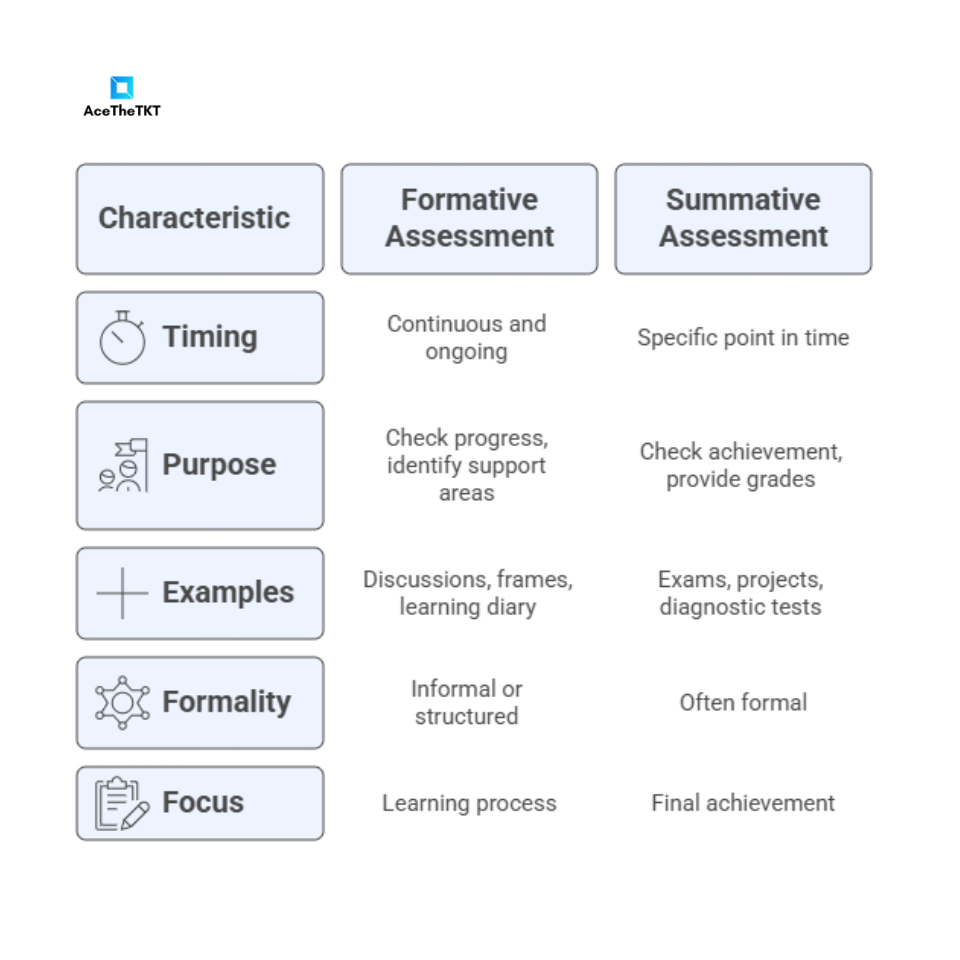
1. Formative Assessment – Assessment for Learning
Formative assessment is continuous and ongoing. It is part of the teaching and learning process, giving teachers and learners feedback while learning is still happening.
Purpose:
- to check progress during learning
- to identify areas where learners need more support
- to adapt teaching and materials based on learner needs
Examples in CLIL ESL classrooms:
- Observing group discussions in a geography class and noting how well learners use terms like urban and rural.
- Giving learners sentence frames during a science experiment (First we…, then we…) and checking their use.
- Asking learners to keep a reflective learning diary in English.
Formative assessment can be informal (teacher questioning, classroom observation) or structured (checklists, mini-presentations, short written reflections).
2. Summative Assessment – Assessment of Learning
Summative assessment measures what learners have achieved at a specific point in time. It usually comes at the end of a unit, term, or course. It is often formal and may include tests, projects, or external examinations. Its purposes are
- to check final achievement
- to provide grades, marks, or qualifications
- to summarise learning progress
Examples in CLIL ESL classrooms:
- A written exam on ecosystems where learners must label diagrams and write a short explanation.
- A history project comparing two civilizations, marked for both accuracy of facts and use of key vocabulary.
- A diagnostic test at the start of a unit to see what learners already know.
Summative assessment is useful for accountability but does not always show the learning process.
Other Types of Assessment in CLIL
One of the biggest questions in CLIL assessment is: How much weight should be given to content and how much to language?
Other Types of Assessment: Peer Assessment
Learners assess each other’s work using agreed criteria.
ESL Example: In a history class, pairs present posters on ancient civilizations. Classmates give feedback on both the content (accuracy of facts) and the language (clarity, vocabulary).
Benefits:
- builds learner autonomy
- encourages collaboration
- develops awareness of quality work
Other Types of Assessment: Self-Assessment
Learners assess their own progress.
ESL Example: After a unit on environmental issues, learners complete an “I Can” checklist:
- I can explain causes of air pollution.
- I can use vocabulary like deforestation, renewable energy.
- I can write a short opinion paragraph about solutions.
This develops metacognition (thinking about learning) and helps learners set personal goals.
Other Types of Assessment: Portfolio Assessment
A portfolio is a collection of learners’ work over time that shows progress in both subject content and language.
ESL Example: In a CLIL art and English class, learners build a portfolio containing:
- labelled sketches of natural objects
- reflective writing on techniques used
- recordings of oral presentations
At the end of the course, learners and teachers review the portfolio together. This gives a full picture of learning rather than just a snapshot.
Other Types of Assessment: Diagnostic Assessment
Diagnostic assessment is used at the beginning of a unit or course to identify what learners already know and where they may need extra support. It helps teachers plan lessons that match learners’ starting points in both content and language.
ESL Example: IIn a CLIL science class, before starting a unit on plants, learners complete simple tasks such as:
- matching pictures of plants to their names
- identifying words like leaf, root, stem
- explaining in basic English what plants need to grow
The teacher uses the results to see which learners already know key concepts and vocabulary and which learners need more scaffolding. This way, lessons can be adjusted to meet learners’ needs right from the start.
Other Types of Assessment: Performance-Based Assessment
Learners demonstrate knowledge and skills by doing tasks.
ESL Example: In a CLIL maths lesson, learners build 3D shapes with materials and then describe the shapes in English to their peers. Assessment is based on accuracy of the shapes (content) and clarity of description (language).
This method reflects real-life application and develops communication.
Types of Assessment Criteria and “Can Do” Statements
Assessment is most effective when learners know exactly what is expected of them. In CLIL, this is often expressed through “Can Do” statements.
Example: Geography (CLIL ESL)
- Learning outcome: To understand the features of a river system.
- Assessment criteria:
- Can label a diagram of a river system.
- Can explain in English the function of a delta.
- Can compare two rivers using appropriate vocabulary.
These clear statements help learners and teachers stay focused.
Types of Assessment Answers
Different assessment tasks require different answer types. In CLIL, teachers should vary tasks to check a range of skills.
- Closed answers: multiple-choice, matching (e.g., label the parts of a plant).
- Open answers: opinion-based responses (e.g., describe how pollution affects your local area).
- Short answers: quick definitions.
- Extended answers: essays or reports.
- Individual or group responses: solo written work vs. collaborative projects.
- Oral or written answers: presentations, debates, or written assignments.
ESL Classroom Tip: Always model the expected type of answer. If you want an extended answer, show learners how to expand ideas beyond one sentence..
Grading and Assessment
Example: Geography (Levels)
- Level 1: gives a factual statement (e.g., “The river is polluted.”)
- Level 2: gives a simple explanation (e.g., “The river is polluted because factories dump waste.”)
- Level 3: gives detailed explanation (e.g., “The river is polluted due to industrial waste and agricultural runoff, which increase nitrate levels.”)
This shows how higher levels require deeper thinking and more precise language.
Example: Music (Grades)
- Grade F: Describes music with limited vocabulary.
- Grade C: Describes effects with some examples.
- Grade A: Detailed description with technical vocabulary (crescendo, dynamics).
For ESL learners, clear rubrics reduce anxiety and make success achievable.
Giving Effective Feedback
Feedback is the heart of formative assessment. It should be specific, constructive, and focused on learning outcomes rather than comparison.
Examples of effective feedback in an ESL geography class:
- Good use of a map. To improve, add more labels to show location clearly.
- You identified changes in the graph correctly. Next time, include exact figures to support your statements.
- Excellent explanation of why industries grew. The amount of detail will help in revision.
Notice how each comment praises strengths while guiding learners toward the next step.
Summary
- CLIL classrooms require assessment of both subject content and language.
- Summative assessment measures achievement at the end; formative assessment supports learning during the process.
- Peer, self, portfolio, and performance assessments enrich the learning experience and promote reflection.
- Clear criteria and rubrics help learners understand expectations.
- Effective feedback motivates learners and shows them how to improve.
Common Questions And Answers
Q1: What is the difference between summative and formative assessment?
Summative is for reviewing learning at the end, while formative supports learning as it happens.
Q2: How can ESL learners benefit from self-assessment?
It helps them reflect on both their subject knowledge and their language skills, making them more independent.
Q3: Why use portfolios in CLIL?
They provide a broad picture of progress, showing growth in both language and subject content over time.
Q4: Should teachers grade language and content separately?
Yes, many CLIL classrooms use dual rubrics to balance accuracy in content with appropriate language use.
Types of Assessment – A Practice Task
For questions 1–7, read the classroom scenarios involving assessment in CLIL for school learners and choose the best option (A, B, or C) that describes the primary purpose of the assessment type.
Mark the correct letter (A, B, or C) on your answer sheet.
1 The teacher gives feedback during a science discussion in English. What is the purpose?
A Monitoring ongoing progress
B Testing final achievement
C Encouraging creative writing
2 Students take a history test at the end of the unit in English. What is the purpose?
A Evaluating overall achievement
B Assessing pronunciation skills
C Simplifying group tasks
3 The teacher uses a pre-test in math to identify learner needs. What is the purpose?
A Diagnosing prior knowledge
B Focusing on vocabulary memorization
C Simplifying lesson delivery
4 Learners assess each other’s geography presentations in English. What is the purpose?
A Promoting collaborative evaluation
B Testing spelling skills
C Encouraging silent work
5 Students reflect on their art project in English. What is the purpose?
A Encouraging self-awareness
B Assessing reading fluency
C Simplifying content
6 Children perform a science experiment in English for grading. What is the purpose?
A Assessing practical application
B Testing listening comprehension
C Encouraging free drawing
7 Students submit a portfolio of history work in English. What is the purpose?
A Showcasing progress over time
B Assessing physical coordination
C Simplifying creative tasks