
Categorizing Learners’ Mistakes

One of the essential skills for any English language teacher is the ability to identify, analyze, and categorize mistakes students make. It’s not about pointing out what’s wrong; it’s about understanding why it’s happening and how we can help. This lesson will break down the frameworks you need to know for the TKT exam and, more importantly, for your classroom.
Learning Outcomes
By the end of this lesson, you will be able to:
- Distinguish between an error and a slip.
- Identify the two main causes of learner errors:
L1 interference and developmental stage. - Categorize mistakes into three main problem areas: accuracy, appropriacy, and communication.
- Provide specific examples of mistakes in grammar, lexis, pronunciation, spelling, punctuation, and style/register.
- Apply this knowledge to inform your teaching and correction techniques.
- Learning Outcomes
- Errors and Slips
- Why Do Learners Make Errors?
- Problems of Accuracy
- Problems of Appropriacy
- Problems of Communication
- Summary: Categorizing Learners’ Mistakes
- Categorizing Learners’ Mistakes: Common Questions And Answers
- Categorizing Learners’ Mistakes – A Practice Task
- Categorizing Learners’ Mistakes – Reference Resources
Errors and Slips
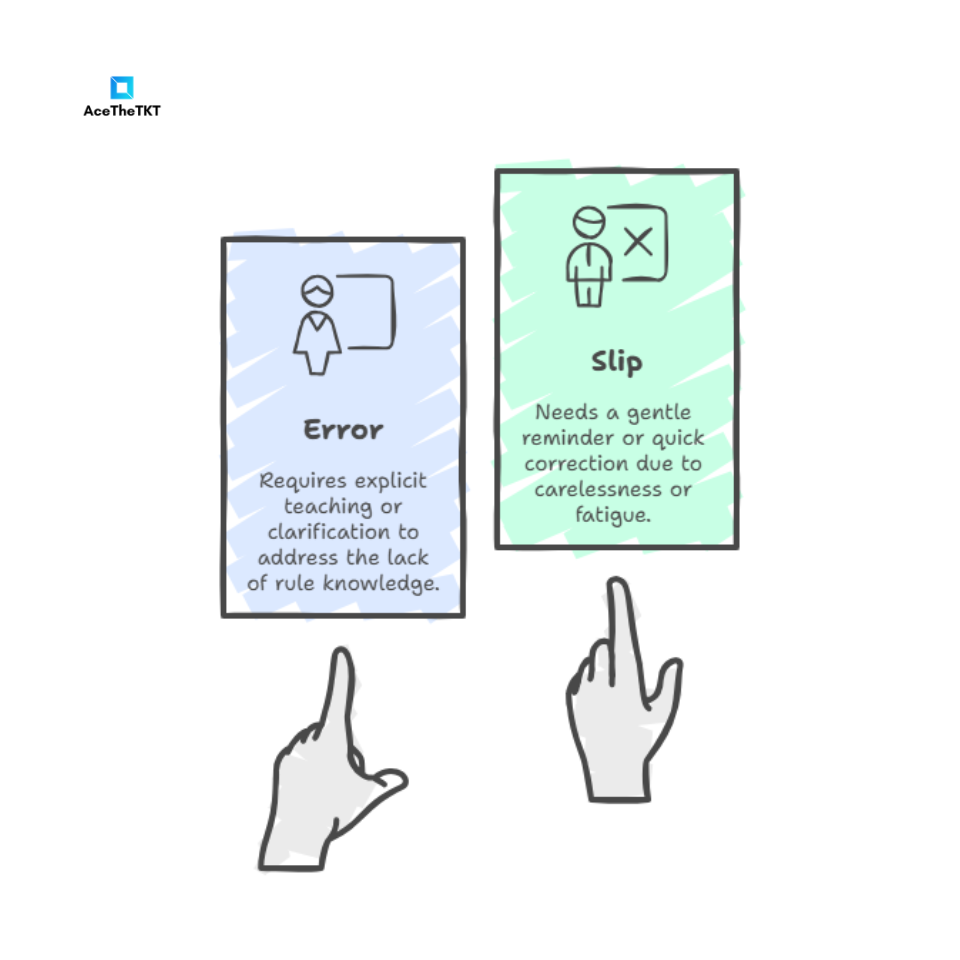
Not all mistakes are created equal. When we categorize mistakes by learners, the first step in categorization is understanding the intention behind the mistake.
- Errors: These occur when a learner doesn’t know the correct rule or form. They are systematic and happen because the learner hasn’t yet internalized the language point. Errors are a natural and positive part of the learning process, showing us what needs to be taught or revisited.
- Example: A student writes, “I go to the cinema yesterday.” (They have not yet mastered the rule for forming the past simple tense).
- Slips: These are mistakes learners make when they actually know the correct rule but fail to use it correctly due to carelessness, fatigue, or lack of concentration. Learners can usually correct slips themselves once the mistake is pointed out.
- Example: A student who knows the past simple very well might say in a quick conversation, “Yes, I go to the party last weekend,” and then immediately correct themselves to “I went.”
Why is this distinction important for teachers? We respond to errors and slips differently. An error often requires explicit teaching or clarification. A slip might just need a gentle reminder or a quick correction.
Why Do Learners Make Errors?
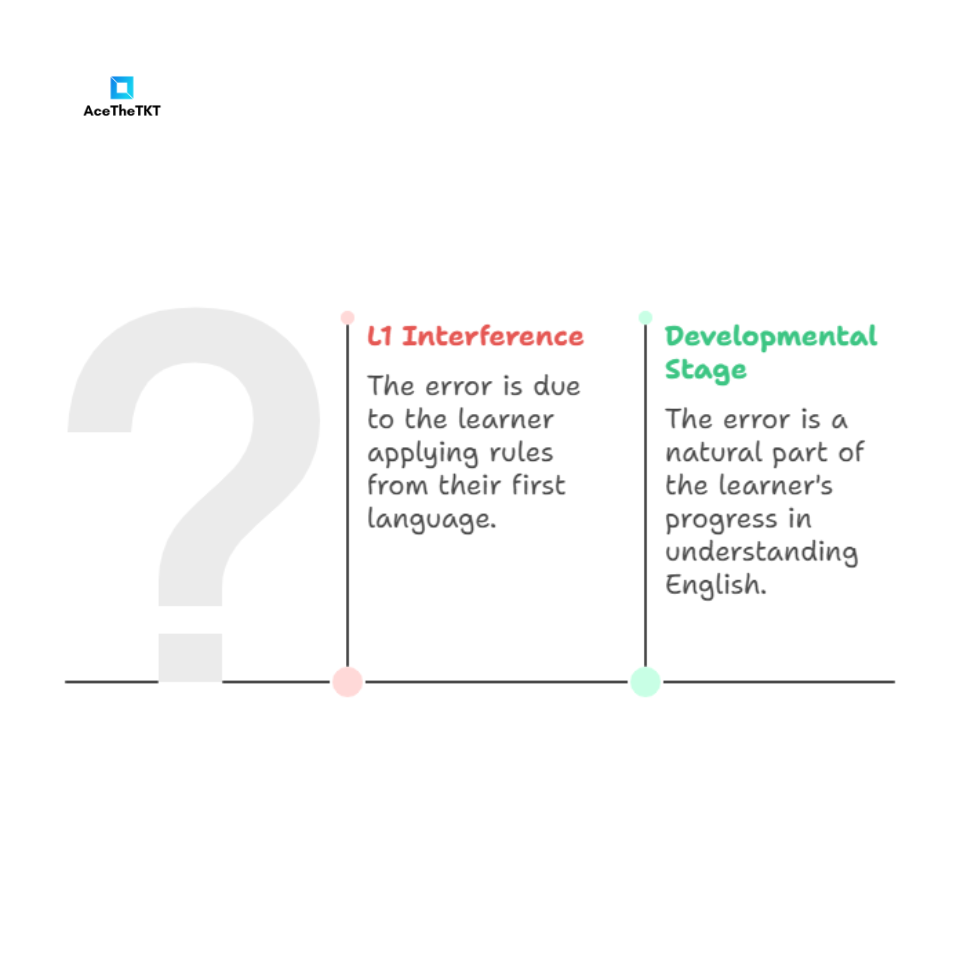
When learners make errors, it is not always a bad thing. Errors can actually give us valuable information about how learners are thinking and progressing. If we understand why an error happens, we can respond in a way that helps the learner improve rather than simply correcting them. There are two main reasons why learners make errors: L1 interference and developmental stage.
Recognizing the source of an error helps teachers decide how to respond and categorize mistakes:
- If the error is caused by L1 interference, the teacher can point out the difference between the learner’s first language and English, and provide practice to build new habits.
- If the error comes from the developmental stage, the teacher can encourage the learner, knowing it is a natural step toward mastery, and gradually introduce more complex rules and exceptions.
L1 Interference (or L1 Transfer)
L1 interference happens when learners bring rules, patterns, or habits from their first language (L1) into English. This is very common and affects many areas of language, such as grammar, word order, pronunciation, vocabulary, and even body language or gestures. Learners are not doing this on purpose; they are trying to use what they already know to understand a new language.
- Grammar Example:
A Spanish speaker might say, “Is raining” instead of “It is raining.”
In Spanish, it is natural to say “Está lloviendo” without using a subject pronoun like it. Because of this habit, the learner leaves out the subject in English too. - Pronunciation Example:
A Japanese speaker might find it difficult to hear or pronounce the difference between /r/ and /l/ sounds.
For example, “frock” and “flock” may sound the same to them because their first language does not distinguish between these two sounds. - Vocabulary (Lexis) Example:
A German speaker might say, “I become a teacher” when they really mean, “I want to be a teacher.”
This happens because in German, the word bekommen means to get, but in English, become has a very different meaning. This kind of mistake is known as a false friend.
Developmental Stage
The second reason learners make errors is related to their stage of development in learning English. As they study, they try to figure out how English works by creating rules in their minds. These rules are often incomplete or too general at first, but they show that learning is taking place. Such errors are a natural part of progress, much like the mistakes children make when learning their first language.
- Example:
A learner may say “goed” instead of “went” when talking about the past.
This shows they have learned that many past tense verbs are formed by adding -ed, such as walk – walked or play – played. However, they do not yet know that go is an irregular verb. Although the sentence is wrong, it is actually a positive sign because it shows the learner is beginning to understand how past tense works.
Problems of Accuracy
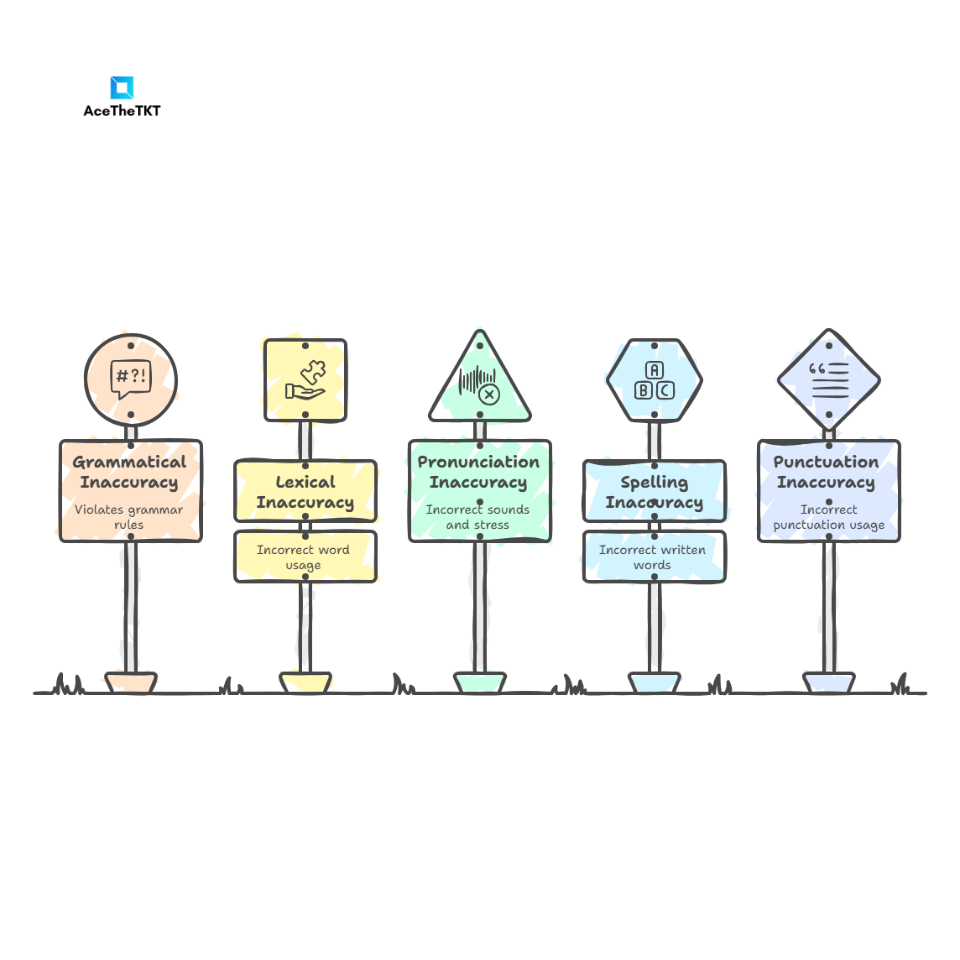
Accuracy is about using the language correctly. When a learner speaks or writes accurately, their grammar, vocabulary, pronunciation, spelling, and punctuation follow the rules of English. If there is a problem with accuracy, it means that something is wrong with the form of the language, even if the meaning is clear.
Problems with accuracy can appear in many areas.
Grammatical Inaccuracy
These errors happen when learners do not follow the grammar rules of English. This includes mistakes with verb tenses, subject-verb agreement, word order, prepositions, articles, and other grammar structures.
- Verb Tense Mistake:
“Yesterday, I go to the market.”
(Should be “Yesterday, I went to the market.”)
The learner used the present tense instead of the past tense. - Subject-Verb Agreement Mistake:
“She play football every day.”
(Should be “She plays football every day.”)
The learner forgot the third-person singular -s. - Preposition Mistake:
“They are interested on science.”
(Should be “They are interested in science.”)
The wrong preposition was used. - Word Order Mistake:
“He speaks very well English.”
(Should be “He speaks English very well.”)
The words are in the wrong order.
Grammatical mistakes are very common, especially for learners who are still building a strong foundation in English.
Lexical Inaccuracy
Lexical inaccuracy happens when learners use the wrong word or combine words incorrectly. It often shows up in word choice, word form, or collocations (words that naturally go together).
- Wrong Verb Choice:
“I made my homework.”
(Should be “I did my homework.”)
The learner used made instead of did. - Wrong Noun or Adjective Choice:
“He has very strong coffee.”
This is acceptable in English, but in some contexts, powerful might be a better choice. Learners need to be aware of subtle differences between words that seem similar. - Wrong Word Form:
“She is a beauty girl.”
(Should be “She is a beautiful girl.”)
The learner used the noun beauty instead of the adjective beautiful.
These errors can make communication confusing, even if the grammar is correct.
Pronunciation Inaccuracy
Pronunciation mistakes happen when a learner says a sound, word, or sentence incorrectly. These mistakes can cause misunderstanding, especially if the word sounds like another English word. Pronunciation inaccuracy may involve:
- Individual Sounds (Phonemes):
“Sink” /sɪŋk/ instead of “Think” /θɪŋk/.
The learner cannot produce the /θ/ sound correctly. - Word Stress:
“RECord” (noun) vs. “reCORD” (verb).
The meaning changes depending on which syllable is stressed. - Sentence Stress and Intonation:
Saying, “You are ready?” with a falling tone instead of a rising tone can make it sound like a statement instead of a question.
Good pronunciation is important for clear communication. Even small pronunciation mistakes can lead to misunderstandings.
Spelling Inaccuracy
Spelling mistakes are common in writing. These errors happen when learners write words incorrectly, either because they are unsure of the spelling or confuse similar-looking words.
- Common Spelling Mistakes:
“Recieve” instead of “Receive”
“Writting” instead of “Writing” - Confusing Homophones:
“There” vs. “Their” vs. “They’re”
Learners may mix these up because they sound the same but have different meanings and spellings.
Spelling mistakes do not usually affect spoken communication, but they can make writing difficult to understand.
Punctuation Inaccuracy
Punctuation mistakes occur when learners use capital letters, full stops, commas, or question marks incorrectly. Proper punctuation is essential for clear writing.
- Misusing Commas or Full Stops:
“Let’s eat grandma!” vs. “Let’s eat, grandma!”
A missing comma can completely change the meaning. - Missing Capital Letters:
“i like english.”
(Should be “I like English.”) - Missing Question Marks:
“whats your name”
(Should be “What’s your name?”)
Problems of Appropriacy
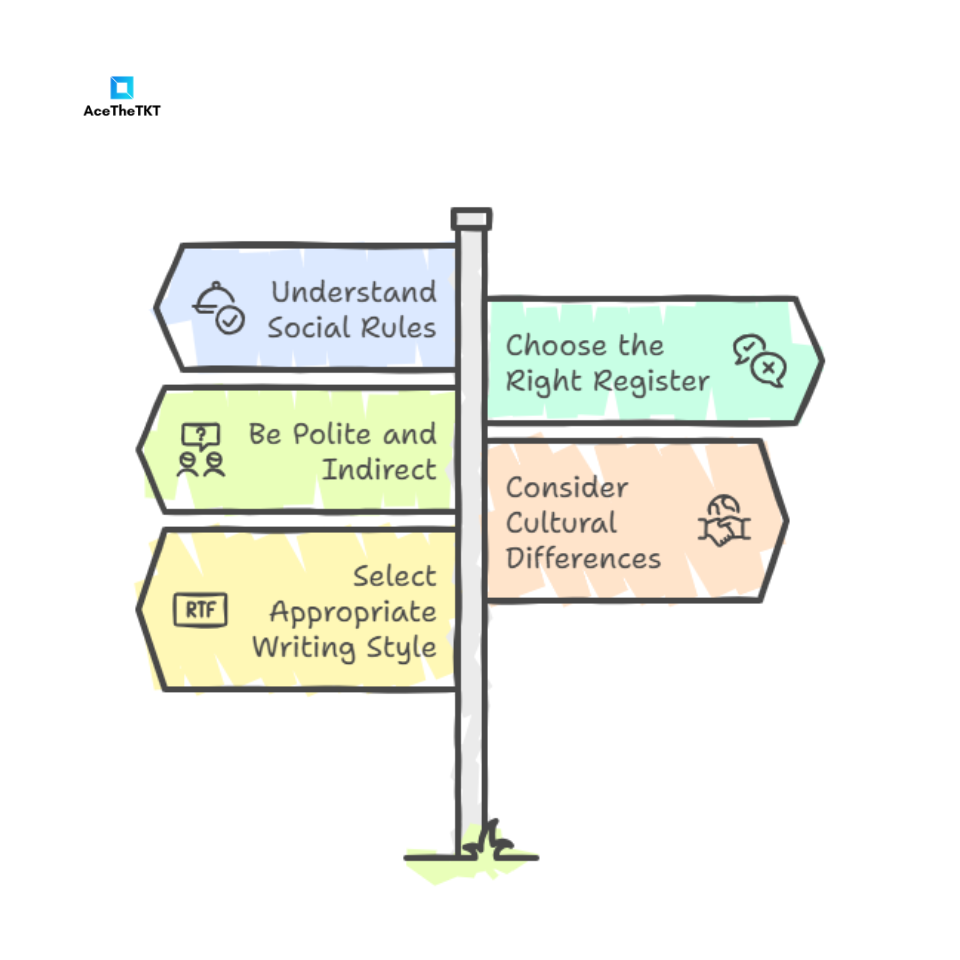
Appropriacy is about choosing language that fits the situation, audience, and context. Even if a sentence is grammatically correct, it can still be inappropriate if the words, tone, or style do not match the circumstances. This is a common issue for language learners because they may focus only on accuracy and forget that how something is said matters just as much as what is said.
Problems of appropriacy usually happen because learners are not yet aware of the social rules and cultural expectations connected to language use. These problems can lead to misunderstandings or make the speaker sound rude, overly casual, too formal, or even disrespectful.
Why Appropriacy Matters
Language is more than grammar and vocabulary. It also carries meaning through politeness, tone, and social relationships.
When learners use language that is inappropriate for a situation, it can:
- Offend or embarrass the listener.
- Make the speaker seem unprofessional or impolite.
- Cause confusion about the speaker’s true intentions.
- Create a poor impression in formal situations like interviews or workplace communication.
For example, saying “Hey dude, what’s up?” to a king is socially inappropriate, even though the grammar is perfect.
Register (Formal vs. Informal Language)
Register refers to how formal or informal the language is. Different situations require different registers.
“I look forward to hearing from you.”
Informal Register:
Used with friends, close family members, or people you know well.
Examples of informal phrases:
“Hey, how’s it going?”
“See you later!”
Formal Register:
Used in professional, academic, or serious situations where politeness and respect are important.
Examples of formal phrases:
“Good morning, how are you today?”
Common mistake:
Using casual language in a very formal context.
- “Hey dude, what’s up?” said to a king or in a business meeting.
- “Cheers, John” at the end of a formal job application email instead of “Yours sincerely, John Smith.”
These errors happen because learners might not fully understand the level of politeness expected in different settings.
Politeness and Directness
Different cultures have different rules about how direct or indirect you should be when asking for something or giving instructions. English often uses indirect, polite forms, especially in formal or semi-formal contexts.
- Too Direct:
“Give me a pen.”
This sounds like a command and may seem rude. - Polite Request:
“Could I borrow a pen, please?”
This is more suitable in most situations, especially when speaking to someone you do not know well.
Another example of directness:
- Too direct: “Close the window.”
- More polite: “Would you mind closing the window, please?”
Learners may be unaware that a direct form, while grammatically correct, can come across as impolite.
Cultural Differences and Context
Sometimes, appropriacy problems happen because the learner is translating directly from their first language without realizing that social rules are different in English.
For example:
- In some cultures, it is normal to address teachers by their first name.
- Saying, “Hi Mary” to a teacher might be fine in one country, but in another, it could seem disrespectful.
- In English-speaking countries, it is common to say “Please” and “Thank you” regularly.
- A learner who forgets these words might appear rude, even if they did not mean to be.
Learners need to understand not only what words to use, but also when and how to use them depending on cultural expectations.
Choosing the Right Style for Writing
Appropriacy is also important in writing, especially in professional or academic settings.
- Informal Writing:
Used in text messages, notes to friends, or casual emails.
Example ending: “See ya, take care!” - Formal Writing:
Used in job applications, official letters, or academic essays.
Example ending: “Yours sincerely, John Smith.”
Common mistake: Mixing the two styles in the same text.
For instance, a learner might write a formal job application but end it with, “Thanks a bunch!” which is too informal for the context.
Problems of Communication
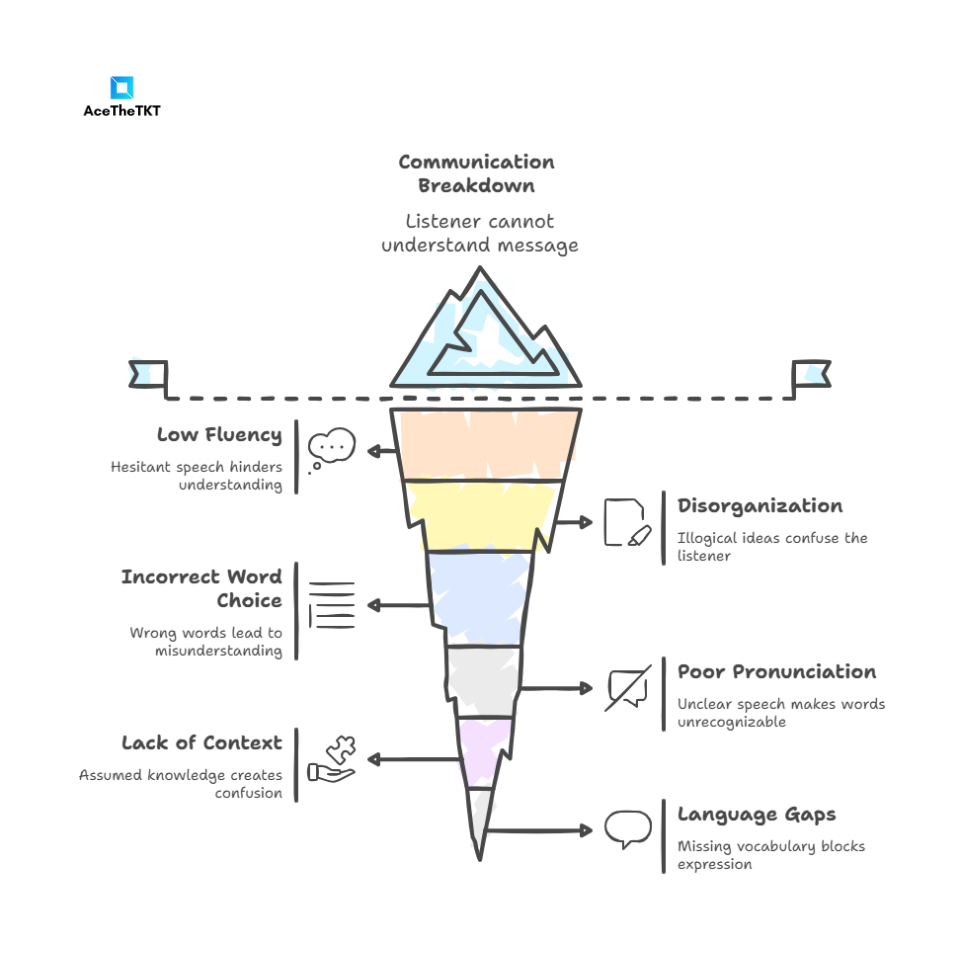
Sometimes, the most serious issue in language learning is not a small grammar mistake or slightly inappropriate language, but a complete breakdown in communication. In these situations, the listener or reader cannot understand the intended message at all. This means the main purpose of language—sharing ideas and information—fails.
Communication problems are often the hardest for learners and teachers to deal with because they stop the conversation from moving forward and can cause frustration on both sides.
Why Communication Breaks Down
A breakdown in communication can happen for many reasons. Unlike accuracy or appropriacy problems, these mistakes are so significant that they block understanding completely. Some common causes include:
- Very Low Fluency – speaking so slowly or hesitantly that the listener loses track of the message.
- Disorganized Writing or Speech – ideas are scattered or illogical, so the reader or listener cannot follow the point.
- Incorrect or Confusing Word Choice – using the wrong words, leading to misunderstanding.
- Poor Pronunciation – speaking so unclearly that individual words cannot be recognized.
- Lack of Shared Context or Background Knowledge – assuming the listener knows information that they do not.
- Language Gaps – the learner does not have the vocabulary or structures needed to express themselves.
Problems with Fluency
Fluency is the ability to speak or write smoothly and naturally. When learners have very low fluency, their speech is full of long pauses, false starts, or repeated hesitations, making it extremely difficult for others to follow.
- Example of a Fluency Breakdown (Speaking):
A learner tries to explain what they did yesterday:
“Uh… I… yesterday… uh… went… uh… the… um… shop… and… uh… uh… buy… uh… bread.” The message is so slow and fragmented that the listener struggles to stay engaged or understand what is being said. - Why This Happens:
- The learner is still translating from their first language in their head.
- They lack automatic control of vocabulary and grammar.
- Nervousness or lack of confidence causes hesitation.
When fluency is very low, even basic conversation becomes tiring for both the speaker and the listener.
Disorganized Writing or Speech
Even if a learner knows the right words and grammar, their message can fail if the ideas are not organized logically. This is especially common in writing, where the reader cannot ask for clarification.
- Example of a Breakdown (Writing):
“The story of my weekend is very nice. Saturday was good because I like shopping. My cousin birthday party came after. The next day rain so I stay home. Shopping is fun with friends. We eat cake.” The reader struggles to understand:- What happened first and what happened later.
- How the sentences connect to each other.
- Which parts are important.
The writing is confusing because it lacks clear structure, transitions, and logical flow.
- Why This Happens:
- The learner is not used to organizing ideas in English.
- They may be thinking in their first language and directly translating sentence by sentence.
- They lack knowledge of text types and how to connect ideas with linking words such as first, then, because, however.
Using the Completely Wrong Word
Sometimes a single incorrect word can completely change the meaning of a sentence, leading to confusion. Unlike a small vocabulary mistake, this kind of error makes the listener misunderstand the entire message.
- Example:
“I put the ice cream in the closet.”
The learner meant to say “I put the ice cream in the freezer.” While the sentence is grammatically perfect, the wrong word (closet) creates a strange mental image, leaving the listener confused. - Why This Happens:
- The learner does not know the correct word and guesses.
- They confuse two words that sound similar or have related meanings.
- They translate directly from their first language, but the English word has a different meaning.
Pronunciation Problems That Block Understanding
Sometimes, pronunciation problems go beyond a slight accent and make speech unintelligible. Even if the grammar and vocabulary are correct, the listener cannot recognize the words.
- Example:
A learner says “bat” when they mean “pat” because they cannot produce the /p/ sound correctly.- “I like batatoes” instead of “I like potatoes.”
If this happens frequently, the listener may give up trying to understand, causing the conversation to break down.
- Why This Happens:
- The learner’s first language does not include certain English sounds.
- The learner has never had focused practice on stress and intonation.
- Speaking too fast or too quietly adds to the problem.
Lack of Shared Context or Background Knowledge
Communication sometimes fails because the speaker assumes the listener knows information they do not. This makes the message incomplete or confusing.
- Example:
A learner says, “He’s coming tomorrow at 5.”- The listener does not know who he is or why this is important.
- Without context, the sentence does not make sense.
This problem often happens when learners skip important background details because they are eager to speak quickly or lack the vocabulary to explain fully.
How to Help Learners Avoid Communication Breakdowns
Teachers can reduce communication problems by:
- Building fluency through pair work, timed speaking activities, and free writing tasks.
- Teaching organization skills such as using linking words, planning ideas before speaking or writing, and practicing text types like letters, essays, and stories.
- Expanding vocabulary so learners have the right words for everyday situations.
- Practicing pronunciation with drills, minimal pairs, and stress/intonation activities.
- Providing real-life contexts in activities so learners understand when and why certain words or structures are needed.
- Encouraging clarification strategies, such as asking, “Sorry, could you repeat that?” or “Do you mean…?” when communication breaks down.
Summary: Categorizing Learners’ Mistakes
- Mistakes can be errors (lack of knowledge) or slips (carelessness).
- The two main causes of errors are L1 interference (first language influence) and a learner’s developmental stage.
- Mistakes cause problems in three key areas:
- Accuracy: The form is wrong (grammar, vocabulary, spelling, pronunciation, punctuation).
- Appropriacy: The language is unsuitable for the context (wrong register/style).
- Communication: The message is not clear or understood.
- Categorizing mistakes helps teachers correct effectively, plan targeted lessons, and foster learner autonomy.
Categorizing Learners’ Mistakes: Common Questions And Answers
Q1. Should I correct every mistake my students make?
No. Correcting every mistake can be demotivating and hinder fluency development. Focus on the lesson aim (e.g., if the lesson is on past tense, focus on correcting past tense errors) and on mistakes that cause serious communication problems or are inappropriate.
Q2.What’s more important: accuracy or fluency?
They are both important, but their importance shifts depending on the activity. During a fluency-speaking task (e.g., a debate), focus on communication. During a controlled practice task or writing assignment, focus more on accuracy. A good lesson plan balances both.
Q3. How can I help students with L1 interference?
Explicitly contrast the English rule with their L1 rule where possible. Raise their awareness of common false friends and tricky pronunciation sounds. Provide plenty of practice and positive reinforcement.
Q4.Are mistakes a sign of bad teaching?
Absolutely not! Mistakes are a natural and essential part of language learning. They provide invaluable insight into a student’s thought process and developmental stage. A classroom with no mistakes is a classroom where students aren’t taking risks or challenging themselves.
Categorizing Learners’ Mistakes – A Practice Task
For questions 1–7, match learners’ mistakes (1-7) with the type of problem (A-D).
You will need to use some of the options more than once.
Type of Problem
A. problem with accuracy
B. problem with appropriacy
C. problem with communication
D. slip (can self-correct)
Learners’ Mistakes
(1) Student (in a formal job interview): “So, what’s the salary for this gig?”
(2) Student writes in an essay: “The government must to invest in renewable energy.”
(3) A student says, “I bought a new computer last week.” Then they quickly say, “I mean, I buy a new computer last week? No… I bought.”
(4) During a presentation, a student speaks in a very low monotone, making it impossible for the audience to hear or follow the key points.
(5) Student: “I am very afraid of dogs because in my childhood one bit me. The dog was very large and had big tooths.”
(6) Student (to the school principal): “Hey, Mr. Smith! Wanna grab a coffee later?”
(7) Student writes in a story: “He was a very sympathetic man; he always helped others.” (The student confuses sympathetic with kind).
Categorizing Learners’ Mistakes – Reference Resources
Textbooks
- “The TKT Course Modules 1, 2 and 3” by Mary Spratt, Alan Pulverness, and Melanie Williams – Includes Unit 29 focused on categorising learners’ mistakes from the Cambridge TKT official course book.
- “Learning Teaching” (2nd Edition) by Jim Scrivener – Contains detailed sections on error correction and categorizing learner errors.
- “Error Correction and Feedback in Language Teaching” – Addresses various types of learner errors and how to handle them in the classroom, relevant for TKT preparation.
- “Teaching by Principles: An Interactive Approach to Language Pedagogy” by H. Douglas Brown – Discusses learner mistakes, including categorization and correction strategies.
- “How to Teach English” by Jeremy Harmer – Covers common learner errors and categorization useful for TKT Module 3.
Online Resources
- Cambridge English TKT Module 3: Categorising Learners’ Mistakes (PDF)
- Onestopenglish TKT Tip 08: Module 3 – Categorizing Learners’ Mistakes (Article)
- Cambridge Core: The TKT Course Modules 1, 2 and 3 – Unit 29 Categorising Learners’ Mistakes
- Scribd Document: Categorising Learners Mistakes (PDF)
- SlideShare Presentation: Categorising Learners’ Mistakes from TKT (PPT)