
Grammar
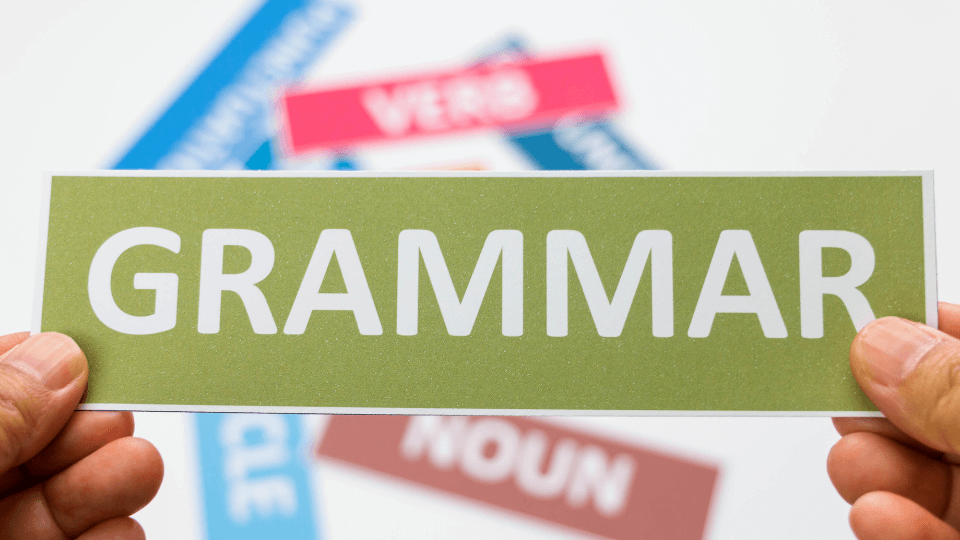
Grammar is the backbone of language learning, giving structure and clarity to communication. In the ESL classroom, teachers often face the challenge of balancing grammatical forms with grammatical uses. While forms show how words and sentences are built, uses explain how those structures convey meaning in real-life situations. For Cambridge TKT candidates, developing a strong understanding of both is essential, not only for passing the test but also for becoming an effective teacher.
Learning Outcomes
By the end of this lesson, you will be able to:
- Define grammar in terms of both forms and uses.
- Identify the main parts of speech and explain their functions.
- Recognise common grammatical structures and their patterns.
- Explain how affixes (prefixes and suffixes) contribute to word building.
- Distinguish between different grammatical uses of the same structure.

What is Grammar?
Grammar is the system of a language. It refers to the way we combine, organise, and change words to make meaning. It gives structure to communication, just as the frame of a building supports its walls. Without grammar, words remain isolated, and communication becomes unclear. With grammar, words connect in logical patterns so that ideas can be understood.
Grammar operates on several levels:
- Words – the smallest units carrying meaning (e.g. book, run, beautiful).
- Phrases – groups of words that work together (e.g. a tall building, in the garden).
- Clauses – groups of words with a subject and a verb (e.g. She was smiling).
- Sentences – complete thoughts that may contain one or more clauses (e.g. She was smiling because she passed the exam).
In the ESL classroom, teachers usually highlight grammar in two main ways:
Forms
Form refers to the patterns, structures, and rules that show how words are arranged. It includes:
- Word endings (-s for plural nouns, -ed for past tense verbs).
- Sentence structures (e.g. subject + verb + object → The boy kicked the ball).
- Word order (e.g. She quickly answered vs. Quickly she answered).
Form is about accuracy. Learners often practise it through gap-fill exercises, sentence transformations, or verb conjugation drills.
Example of form:
- subject + auxiliary verb + main verb-ing → She is reading.
Here, the structure follows a clear pattern: subject (she) + auxiliary (is) + main verb (read) + ending (-ing).
Uses
Use refers to the meaning that grammar communicates in context. The same form can be used in different ways, depending on the situation. Teachers often say that “form is the shell, and use is the message inside it.”
Example of use (Present Continuous):
- She is reading can mean:
- An action happening now (She is reading at the moment).
- A fixed plan (She is reading at the library tomorrow morning).
- A temporary situation (She is reading a lot these days because of exams).
Use is about communication. Learners practise it through role-plays, storytelling, and tasks where they must choose the correct structure based on meaning.
Parts of Speech
English has nine parts of speech, also known as word classes. Each word class has a distinct function in a sentence, and together they form the building blocks of communication. Understanding these categories is essential for ESL learners because it helps them see how words fit together. For teachers, recognising parts of speech makes it easier to explain grammar, correct errors, and design practice activities. Here are the nine parts of speech in brief with their subcategories you will need for TKT.
Nouns
Nouns are words that name people, places, things, ideas, or qualities.
- My students enjoy music.
- London is a busy city.
Types of nouns:
- Collective nouns: groups (team, family).
- Countable nouns: can be counted (book, chair).
- Uncountable nouns: cannot be counted (water, advice).
- Proper nouns: names of specific people or places (Sri Lanka, Maria).
- Common nouns: general names (teacher, school).
- Abstract nouns: ideas or qualities (happiness, honesty)
Verbs
Verbs express actions, states, or experiences.
- She sings beautifully.
- They are watching a movie.
Types of verbs:
- Multi-word verbs: phrasal verbs (take off, look after).
- Transitive: need an object (She plays the piano.).
- Intransitive: no object (He sleeps well.).
- Regular: past tense formed with -ed (walk → walked).
- Irregular: change form (go → went).
- Auxiliary verbs: help form tenses (be, have, do).
- Modal verbs: express ability, possibility, necessity (can, must, should).
Adjectives
Adjectives give more information about nouns.
- The tall student answered first.
- It was a difficult exam.
Types of adjectives:
- Superlative: compare more than two (biggest, most expensive).
- Comparative: compare two things (bigger, more expensive).
Adverbs
Adverbs describe how, when, where, or to what extent something happens.
- They worked quickly.
- She often visits her grandmother.
Types of adverbs:
- Attitude markers (fortunately, sadly).
- Manner (slowly, carefully).
- Time (yesterday, soon).
- Place (here, upstairs).
- Frequency (always, sometimes).
- Degree (very, quite).
- Focus (only, even).
Determiners
Determiners specify which noun is being referred to.
- This book is mine.
- Both children are ready.
Types of determiners:
- Quantifiers (some, many, few, all).
- Articles (a, an, the).
- Demonstratives (this, that, these, those).
- Possessives (my, your, their).
Prepositions
Prepositions show the relationship between words, usually of place, time, or direction.
- The bag is under the chair.
- We met after the lesson.
Types of prepositions:
- Contrast/cause (despite, because of).
- Time (at, during, since).
- Place (on, under, beside).
- Direction (into, towards).
Pronouns
Pronouns replace nouns to avoid repetition.
- He is my friend.
- This is theirs.
Types of pronouns:
- Demonstrative (this, those).
- Personal (I, you, he, she).
- Possessive (mine, yours, theirs).
- Relative (who, which, that).
- Reflexive (myself, yourself).
Conjunctions
Conjunctions connect words, clauses, or sentences.
- I stayed at home because it rained.
- She likes both apples and bananas.
Types of conjunctions:
- Correlative (both…and, either…or).
- Coordinating (and, but, or).
- Subordinating (because, although, if).
Exclamations
Exclamations express strong feelings, usually in informal spoken English.
- Ouch! That hurt.
- Wow! That’s amazing.
TKT Exam Task Relevance:
Parts of Speech
Candidates may need to:
- Match words to their part of speech.
- Identify which part of speech is underlined in a sentence.
- Recognise learner errors related to parts of speech.
- Decide how to teach or practise a part of speech in a classroom context.
Grammatical Structures
Grammatical structures are the arrangements or patterns of words that create meaning. They show how different parts of speech combine at the level of phrases, clauses, and sentences. While individual words carry meaning, grammatical structures determine how those words interact and how messages are communicated. For example, the same set of words can change meaning when rearranged:
- The cat chased the dog. (The cat is the subject, the doer of the action.)
- The dog was chased by the cat. (The dog becomes the subject, but it is not the doer.)
Both sentences use the same vocabulary but different structures, and this changes how the information is presented.
Progressive Forms
Definition
Progressive (or continuous) forms describe actions in progress. They combine a form of the verb to be with the -ing form of the main verb.
Form and Examples
- Present Progressive: subject + am/is/are + verb-ing
- She is studying now.
- Past Progressive: subject + was/were + verb-ing
- They were playing football when it started to rain.
- Future Progressive: subject + will be + verb-ing
- I will be working tomorrow at 10.
Uses
- Present: action happening at the moment, temporary situations, future arrangements.
- Past: action in progress at a specific time, interrupted action.
- Future: action that will be happening at a future time.
Common Learner Problems
- Forgetting the auxiliary (She studying now instead of She is studying).
- Using progressive with stative verbs (I am knowing the answer instead of I know).
- Confusing past simple and past progressive.
TKT Relevance
Tasks may ask candidates to identify the difference between past simple and past progressive or to match uses (temporary vs. habitual).
Contrast Clause
Definition
Contrast clauses show a difference between two ideas. They are introduced by subordinating conjunctions like although, though, even though.
Form and Examples
- conjunction of contrast + clause
- Although it was cold, they went swimming.
- Even though she was tired, she continued working.
Uses
- To highlight unexpected results.
- To balance two opposing ideas.
Common Learner Problems
- Using but with although (Although it was cold, but they went swimming).
- Confusing contrast conjunctions (Despite she was tired instead of Despite being tired).
- Forgetting subject-verb agreement in the clause.
TKT Relevance
Tasks may ask candidates to identify contrast clauses or explain their communicative purpose in a text.
Active Voice
Definition
The active voice is a grammatical structure where the subject of the sentence performs the action of the verb. It is the most common sentence pattern in English and is usually simpler and more direct than the passive voice.
Form and Examples
- subject + verb + object
- The teacher explained the lesson.
- My friend baked a cake.
- They are repairing the road.
Uses
- To state facts and describe everyday actions.
- Birds build nests in trees.
- To highlight the agent (the doer of the action).
- The police arrested the thief.
- To keep sentences clear, short, and natural.
- Preferred in spoken English and most written English, except when the passive is needed for emphasis or formality.
Common Learner Problems
- Learners sometimes confuse active and passive forms, especially when changing between them. Example:
- Error: The thief caught by police.
- Correction: The police caught the thief. (active) / The thief was caught by police. (passive)
- Overusing passive constructions when active voice would be more natural.
- Misplacing word order in questions or negatives.
- What you are doing? instead of What are you doing?
TKT Relevance
In the TKT exam, candidates may be asked to:
- Match examples to functions, e.g., Active voice = focusing on the subject as doer of the action.
- Identify whether a sentence is in the active or passive voice.
- Convert active sentences into passive, or vice versa.
- Recognise when active or passive voice is more appropriate in classroom contexts.
Passive Voice
Definition
The passive voice changes the focus of a sentence from the doer (agent) to the action or the receiver of the action.
Form and Examples
- subject + be + past participle (+ by + agent)
- The letter was written yesterday.
- The song was sung by the choir.
Uses
- When the doer is unknown, unimportant, or obvious.
- To emphasise the action or result rather than the agent.
- Common in scientific, academic, and formal writing.
Common Learner Problems
- Forgetting the correct tense of be (The letter is written yesterday instead of was written).
- Using the active form incorrectly (The cake ate by children).
- Overusing by when it is not necessary.
TKT Relevance
Tasks may test recognition of active vs. passive voice or ask candidates to explain why the passive was chosen in a text.
Comparatives
Definition
Comparative forms are used to compare two people, things, or situations.
Form and Examples
- One-syllable adjectives: adjective + -er (+ than)
- This street is quieter than the main road.
- Two-syllable or longer adjectives: more + adjective (+ than)
- This book is more interesting than that one.
- Superlatives: adjective + -est / most + adjective
- She is the tallest in the class.
Uses
- To compare qualities, quantities, or actions.
- To describe differences.
Common Learner Problems
- Double marking (more easier instead of easier).
- Omitting than in comparisons.
- Using most instead of more (the most bigger).
TKT Relevance
Tasks may ask candidates to identify comparative structures or match examples to functions (e.g., showing difference, emphasis).
Prepositional Phrases
Definition
A prepositional phrase begins with a preposition and is followed by a noun phrase.
Form and Examples
- preposition + noun phrase
- She waited in front of the cinema.
- The book is on the table.
Uses
- To show place (on the desk, under the chair).
- To show time (at night, during the lesson).
- To show direction (into the garden, towards the station).
- To express abstract relationships (because of the rain, in spite of the delay).
Common Learner Problems
- Direct translation from L1 (married with instead of married to).
- Using the wrong preposition (good in maths instead of good at maths).
- Omitting the article in the noun phrase (in front cinema).
TKT Relevance
Candidates may be asked to identify prepositional phrases in sentences or correct misuse of prepositions.
Conditional Sentences
Definition
Conditional sentences express a relationship between a condition (the “if” part) and a result (the main clause).
Forms and Examples
- Zero Conditional: If + present simple, present simple
- If you heat water, it boils. (general truth, fact)
- First Conditional: If + present simple, will + base verb
- If I study, I will pass the exam. (real future possibility)
- Second Conditional: If + past simple, would + base verb
- If I had more time, I would learn Italian. (hypothetical/unreal present or future)
- Third Conditional: If + past perfect, would have + past participle
- If she had studied, she would have passed the test. (imaginary past situation)
Uses
- Zero: Facts, scientific truths.
- First: Real or possible situations in the future.
- Second: Unreal or hypothetical situations in the present/future.
- Third: Imaginary past, regrets, or criticism.
Common Learner Problems
- Confusing second and third conditional (e.g., If I would have studied, I passed).
- Using “will” in the if-clause (If I will see her, I will tell her instead of If I see her…).
TKT Relevance
TKT exam tasks may ask candidates to:
- Identify which type of conditional is used.
- Match examples to uses.
- Correct errors learners might make with conditionals.
Relative Clauses
Definition
Relative clauses describe or give more information about a noun. They usually start with a relative pronoun.
Forms and Examples
- Defining Relative Clauses: essential information.
- The man who lives next door is a teacher.
- Non-defining Relative Clauses: extra information (set off by commas).
- My mother, who is retired, enjoys gardening.
Relative pronouns: who, which, that, whose, where, when.
Uses
- To link ideas.
- To avoid repetition.
- To add detail.
Common Learner Problems
- Omitting necessary pronouns (The man lives next door is a teacher).
- Overusing that in place of who or which.
- Forgetting commas in non-defining clauses.
TKT Relevance
In exam tasks, candidates may:
- Identify whether a clause is defining or non-defining.
- Spot incorrect pronoun use.
- Match example sentences to grammatical terms like “relative clause.”
Reported Speech
Definition
Reported speech (or indirect speech) is used to repeat what someone else has said, without quoting their exact words.
Forms and Examples
- Direct Speech: She said, “I am tired.”
- Reported Speech: She said (that) she was tired.
Typical Changes
- Tense backshift: present → past (I am → she was).
- Pronouns: adjusted to fit the new speaker/listener.
- Time and place words: now → then; today → that day; here → there.
Uses
- To report what someone else has said.
- To summarise without repeating exact words.
Common Learner Problems
- Forgetting to change the tense (She said she is tired instead of was tired).
- Misusing pronouns (He said I was late instead of she was late).
TKT Relevance
Exam questions may ask candidates to:
- Recognise the changes from direct to reported speech.
- Match examples to reported functions (statements, questions, commands).
- Identify incorrect learner sentences and explain why.
Question Forms
Definition
Question forms are structures used to ask for information, confirmation, or clarification.
Types and Examples
- Yes/No Questions: auxiliary + subject + main verb
- Do you like coffee?
- Wh- Questions: wh-word + auxiliary + subject + main verb
- Where are you going?
- Tag Questions: statement + short question at the end
- You’re coming, aren’t you?
- Indirect Questions: polite forms
- Could you tell me where the station is?
Uses
- Yes/No: closed responses.
- Wh-: ask for specific information.
- Tag: confirm information or seek agreement.
- Indirect: politeness and formality.
Common Learner Problems
- Omitting auxiliaries (Where you go? instead of Where are you going?).
- Word order mistakes (You like coffee? instead of Do you like coffee?).
- Misusing tags (You’re a teacher, isn’t it?).
TKT Relevance
Exam tasks may require candidates to:
- Identify the type of question.
- Spot errors in learner examples.
- Match a question form to its communicative function.
Grammatical Uses
Grammar is not only about how sentences are formed (form) but also about the meaning and function those structures carry in different situations (use). The same grammatical structure may express different ideas depending on context. For TKT candidates, it is important to distinguish between form (the pattern of words) and use (what the speaker or writer is trying to communicate).
Present Simple
Form:
subject + base verb (with -s for third person singular)
Examples and Uses
- State (permanent fact or truth):
I live in London.
→ Refers to something generally true over a long period. - Scheduled future (timetable, programme, fixed event):
The train leaves at 6 pm.
→ Although the form is “present,” the meaning is future, based on a fixed schedule. - Habitual or repeated action:
He writes stories in his free time.
→ Used for routines, habits, or repeated events. - Storytelling / commentary (less common but useful to know):
So, he opens the door and sees a stranger waiting outside.
→ Used in jokes, sports commentary, or informal narratives.
Common Learner Problems
- Confusing timetable future with will: The train will leave at 6 pm (grammatical, but less natural when referring to schedules).
- Learners often forget the third-person singular -s (She live in London).
Present Continuous
Form:
subject + am/is/are + verb-ing
Examples and Uses
- Action happening now (immediate time of speaking):
She is cooking dinner now.
→ The activity is in progress at this very moment. - Future arrangement (fixed plan):
She is meeting her cousin tomorrow.
→ The structure communicates a definite plan, often connected to a diary or schedule. - Temporary activity (around the present, but not necessarily at the moment):
She is studying a lot these days.
→ Indicates a short-term routine, not a permanent habit.
Common Learner Problems
- Learners confuse “future arrangement” with “future intention,” mixing it with will.
- Learners sometimes overuse present continuous for permanent states: I am living in London (instead of I live in London).
Affixes:
Prefixes and Suffixes
Affixes are groups of letters added to a base word (also called a root word) that change either its grammatical function or its meaning. They are central to understanding how English grammar works, because they influence:
- Word endings for grammatical purposes (plural, tense, aspect).
- The word class of a word (noun, verb, adjective, adverb).
- The meaning of a word (positive vs. negative, degree, time, etc.).
By recognising affixes, learners can understand why words change form in sentences and how grammar shapes communication.
Prefixes
Definition
A prefix is added to the beginning of a word. Prefixes usually change the meaning, but they do not normally change the word class.
Examples
- un- + happy → unhappy (changes meaning to opposite).
- dis- + agree → disagree (changes meaning to opposite).
- re- + write → rewrite (changes meaning to again).
Influence on Grammar
- The prefix changes meaning, but the word still behaves grammatically as an adjective.
- Prefixes rarely provide grammatical information (tense, number, aspect).
- Instead, they influence meaning within the same word class, which affects how sentences are understood.
- Example: possible (adjective) → impossible (adjective).
Suffixes
Definition
A suffix is added to the end of a base word. Suffixes can change both meaning and word class.
Examples
- teach + -er → teacher (verb → noun).
- hope + -less → hopeless (noun → adjective).
- quick + -ly → quickly (adjective → adverb).
Influence on Grammar
Suffixes play a much bigger role in grammar than prefixes:
careful vs. careless (both adjectives, but opposite meanings).
Indicating grammatical information
- Plural nouns: book → books
- Past tense verbs: walk → walked
- Present participle: play → playing
These endings show number, tense, or aspect, which are crucial for sentence grammar.
Changing word class (derivational suffixes)
- Verb → Noun: develop → development
- Noun → Adjective: danger → dangerous
- Adjective → Adverb: happy → happily
These changes allow words to take on new grammatical roles in sentences.

Summary: Grammar
- Grammar has two sides: forms (how language is structured) and uses (how meaning is communicated).
- The nine parts of speech form the building blocks of English sentences.
- Grammatical structures include patterns like passive voice, comparatives, and prepositional phrases.
- Affixes (prefixes and suffixes) change word meaning, class, or function.
- A single structure can serve different grammatical uses depending on context.
- In teaching, balance accuracy and communication by linking form to real-life use.

Noel’s Questions and Answers Corner
Do all learners need grammar terminology?
Not always. The usefulness of grammar terminology depends on the age, level, and learning style of the learners. Adult learners often appreciate explicit explanations with terms such as past perfect or modal verbs, because these give them labels to organise their knowledge and compare with their first language. For example, a student preparing for IELTS might find it helpful to learn that would have gone is part of the third conditional.
For TKT purposes, candidates should know that terminology is a tool, not a goal. It helps some learners, but not all. Effective teachers adjust their approach based on who is in the classroom.
What is the difference between grammatical form and use?
Grammatical form is the structure — how words are arranged and combined. It is about the “shape” of language. For example: He is running follows the form: subject + auxiliary verb + main verb-ing.
Grammatical use, however, is about meaning in context. The same form can be used in different ways:
- He is running now → an action in progress.
- He is running in a race tomorrow → a future arrangement.
- He is running a lot these days → a temporary habit.
This shows that form does not always equal one fixed meaning. Learners often master forms (e.g., conjugating verbs correctly) but still misuse them in communication. Teachers therefore need to highlight both.
In the TKT exam, candidates are often tested on distinguishing between form and use, so being able to explain the difference is essential.
Should I teach grammar through rules or communication?
Both are important, and the most effective lessons combine the two. Teaching only rules can make lessons dry and disconnected from real communication. Learners may know that the third person singular adds -s but still struggle to use it naturally in conversation. Teaching only communication may help fluency but can leave learners making repeated errors without correction.
The recommended approach is a balance:
- Start with a meaningful context (a dialogue, picture, or story).
- Guide learners to notice the rule within the context (e.g., all the verbs in -ing in a conversation about what people are doing).
- Provide controlled practice for accuracy (gap-fills, sentence transformations).
- Move to freer practice where learners use the structure to communicate (role-plays, problem-solving tasks).
This balance ensures that learners not only understand the rules but also apply them in real-life situations.
How can I make grammar lessons interesting?
Grammar lessons become engaging when they are connected to real communication rather than just abstract rules. Teachers can:
- Use games: for example, “grammar auctions,” where learners bid on sentences they think are correct.
- Include role-plays: learners act out real-life situations (ordering food, making holiday plans) that require specific grammar.
- Bring in real-world materials: menus, bus schedules, or news articles provide authentic contexts for grammar.
- Encourage learner creativity: ask students to write funny stories using comparatives (This house is bigger than a castle!).
The key is variety — mixing controlled drills with interactive tasks. When grammar is linked to communication, learners see it as a tool for expression rather than a set of rules to memorise.
Why does TKT test both form and use?
Because an effective teacher needs to understand not only how grammar is formed but also how it functions in real communication. Knowing forms allows teachers to explain and correct errors (subject + auxiliary + main verb), while knowing uses allows them to show learners when and why to use a structure.
For example, teaching the present continuous without discussing its different uses (action now, future plan, temporary situation) leaves learners with a limited view. Similarly, teaching only uses without the forms can result in learners producing inaccurate sentences.
The TKT exam therefore includes tasks on both. A typical question might ask candidates to identify a form (Which structure is present continuous?) or a use (What meaning does “She is leaving tomorrow” express?). By testing both, TKT ensures that teachers are prepared to give learners a complete understanding of grammar.

TKT Exam Practice Tasks: Grammar
TKT Unit 1 Grammar: Practice Task 1 – Parts of Speech
Instructions:
For questions 1–7, match each bold-faced word in sentences(1–7) with the parts of speech (A–G). There is one correct answer for each.
Parts of speech
A. Noun
B. Verb
C. Adjective
D. Adverb
E. Preposition
F. Pronoun
G. Conjunction
Sentences
- Only the manager approved the draft.
- I had my laptop repaired yesterday.
- That was an unusual claim.
- He left before I arrived.
- The poor need affordable housing.
- The baby is asleep.
- I like the book about whales.
TKT Unit 1 Grammar: Practice Task 1 – Grammatical Structures
Instructions:
For questions 1–7, match each bold-faced word in sentences(1–7) with the grammatical structure it uses(A–G). There is one correct answer for each.
Grammatical Structure
A. Comparative / Superlative structure
B. Future intention
C. Prepositional phrase
D. Passive voice
E. Contrast clause
F. Past continuous
G. Conditional sentence
Sentences
- She was cooking when the phone rang.
- This poem was written by an unknown author.
- If I had a car, I would drive to work.
- The children are sitting under the tree.
- He is the tallest player in the team.
- Although she was tired, she finished the project.
- We are going to visit our grandparents tomorrow.
TKT Unit 1 Grammar: Practice Task 3 – Grammatical Uses
Instructions:
For questions 1–7, match each bold-faced phrase in sentences(1–7) with the purpose of the tense or structure (A–G). There is one correct answer for each.
Grammatical Purpose of Tense/Structure
A. Action happening now
B. Action in progress when another happened
C. Scheduled future event
D. Habitual or repeated action
E. Temporary action around now
F. Completed past action with present relevance
G. Future arrangement
Sentences
- She is teaching online this week because her school is closed.
- The train leaves at 8:30 tomorrow morning.
- He writes poems in his free time.
- Look! The children are playing in the park.
- I have seen that film before.
- She is meeting her friend at the café tonight.
- We were watching TV when the lights went out.

Reference Resources: Grammar
Textbooks
- Practical English Usage by Michael Swan
- English Grammar in Use by Raymond Murphy
- Organized in bite-sized units with clear explanations and exercises. Great for reinforcing grammar points with learners. You can assign units corresponding to your lesson (e.g. passive, continuous, comparatives) for extra practice.
- Grammar for English Language Teachers by Martin Parrott
- Combines grammar explanation with classroom teaching ideas. Many TKT trainers and teachers find this helpful for planning lessons.
- The English Tenses by Phil Williams
- Focused entirely on tenses: it lays out forms, uses, timelines, and exceptions in a very accessible way.
- Good book to use when you want to deepen students’ understanding of temporal uses (continuous, perfect, etc).
- Longman Grammar of Spoken and Written English by Biber, Johansson, Leech, Conrad & Finegan
Online Resources
- Cambridge English – Prepare for TKT
– Contains sample papers, handbooks, and glossaries for all TKT modules

Previous Lesson: (None)
Next Lesson: Lexis
Home: Module 1 Lesson Navigator