
Phonology
Phonology is the study of sound features in a language. For ESL teachers, it is more than just “teaching pronunciation.” It covers how sounds work together, how meaning changes when stress shifts, and how intonation conveys feelings or functions. A learner may know grammar and vocabulary but still face difficulty being understood if their phonological control is weak. A learner may say “I CAN go” when they mean “I can GO”, using the wrong sentence stress. These problems can cause confusion or unintended humour. Phonology teaching, therefore, equips learners not only to produce English sounds clearly but also to decode natural spoken English from different speakers around the world.
Learning Outcomes
By the end of this lesson, you will be able to:
- Define phonology and explain why it matters in ESL classrooms.
- Distinguish between phonemes, phonemic symbols, and phonemic script.
- Recognise the role of word stress, sentence stress, and contrastive stress in communication.
- Identify features of connected speech, including weak forms, contractions, linking, and rhythm.
- Use intonation patterns to signal meaning, emotion, and attitude.
- Apply classroom strategies to help learners notice, practise, and improve pronunciation.
- Understand common learner difficulties and practical solutions when teaching phonology.
- Phonology

Phonemes and Phonemic Symbols
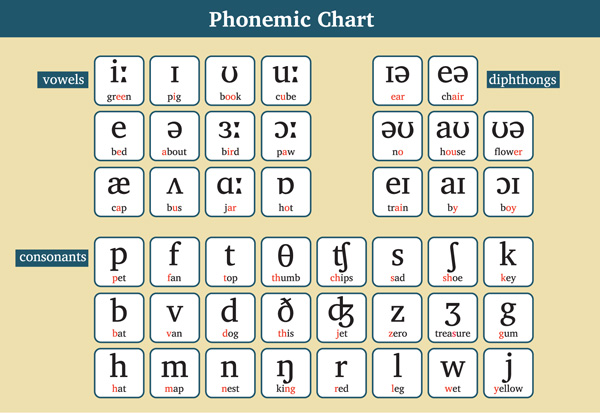
A phoneme is the smallest unit of sound that changes meaning. Phonemes are represented in writing by phonemic symbols. Unlike letters of the alphabet, which can have multiple sounds, each phonemic symbol represents only one sound.
What are phonemes?
A phoneme is the smallest unit of sound that can change meaning in a language. Changing just one phoneme in a word can completely alter its meaning.
- For example, pin and bin differ only in the initial sound. The phoneme /p/ at the start of pin changes to /b/ in bin, creating two distinct words with unrelated meanings.
- Similarly, bat and pat differ by a single phoneme /b/ vs. /p/, showing how vital phonemes are for communication.
Phonemes are abstract units. The way they are produced may vary slightly in real speech (these variations are called allophones), but as long as the difference does not change meaning, they are still considered the same phoneme. For example, the /p/ in spin (which is unaspirated) and the /p/ in pin (which is aspirated) sound a little different, but both belong to the phoneme /p/ in English.
ESL classroom example: A teacher introduces the words sip and ship. Learners look at two pictures: one of someone drinking from a cup (sip), and another of a boat (ship). They practise saying both words and matching them to the correct pictures. This helps them notice that /s/ and /ʃ/ are different phonemes in English, even though the difference may seem small to their ears.
Phonemic symbols and script
Because English spelling is not a reliable guide to pronunciation, teachers and learners often use phonemic symbols. Each symbol represents exactly one sound. This system removes the confusion caused by the irregular relationship between spelling and sound in English.
- For example, the letter a in spelling can represent several different sounds:
- /æ/ in cat
- /eɪ/ in late
- /ə/ in sofa
By contrast, the phonemic symbol /æ/ always represents the short vowel in cat, no matter how it is spelled in different words.
When a word is written using phonemic symbols, this is called a phonemic transcription. For example:
- teacher → /ˈtiːtʃə/
- enough → /ɪˈnʌf/
- phone → /fəʊn/
Phonemic transcription shows learners the exact pronunciation, including stress, which is not always obvious from the spelling.
Why are phonemic symbols useful?
- Clarity – They show the exact sounds learners need to produce.
- Consistency – One symbol always represents the same sound, unlike English spelling.
- Dictionary skills – Many learner dictionaries use phonemic transcription, helping students check pronunciation independently.
- Awareness – Seeing the symbols helps learners recognise problem sounds and compare them with their first language.
How to practice the IPA symbols
You can use the phonemic chart (based on the International Phonetic Alphabet) to make sounds visible and memorable. Here are some practical ways:
Games: Use symbol cards for matching activities (e.g., match /ʃ/ with shoe, she, shy). You can also spell their names or favourite foods in phonemic script as a fun activity.
Introduce gradually: Don’t expect you to memorise all symbols at once. Start with those that represent sounds you often get confused with, such as /θ/ (think) and /s/ (sink).
Model and repeat: When learning new vocabulary, model the word, then look at its phonemic transcription. Repeat it several times and notice the stressed syllable.
Visual reference: Hang a phonemic chart in your study room. Point to the symbols randomly, and make sure you can connect sound and symbol.
Learner dictionaries: Use dictionaries that include phonemic transcriptions. Look up the phonemic transcription of a word and produce its pronunciation.
Vowels, Diphthongs, and Consonants
English phonemes are traditionally grouped into three main categories: vowels, diphthongs, and consonants. Understanding these groups helps teachers explain pronunciation clearly and gives learners a framework for noticing sound differences.
Vowels
Definition: Vowels are sounds made when the air flows freely through the mouth, without being blocked by the tongue, teeth, or lips. The main difference between vowels comes from the position of the tongue (high/low, front/back) and whether the lips are rounded or unrounded.
Examples in English:
- /iː/ as in see
- /ɪ/ as in sit
- /æ/ as in cat
- /uː/ as in food
- /ʌ/ as in cup
Key features:
- The schwa /ə/ is the most common vowel in English, often used in unstressed syllables (sofa, teacher).
- Vowels can be short (/ɪ/ in bit) or long (/iː/ in beat).
Diphthongs
Definition: A diphthong is a glide from one vowel sound to another within a single syllable. The tongue moves during pronunciation, and the quality of the vowel changes.
Examples in English:
- /aɪ/ as in time
- /eɪ/ as in day
- /ɔɪ/ as in boy
- /aʊ/ as in cow
- /əʊ/ as in go
Key features:
- Diphthongs are dynamic sounds, not fixed. The starting vowel moves smoothly into the ending vowel.
- Learners often “freeze” the first vowel and fail to glide into the second, which makes their pronunciation sound incomplete.
Consonants
Definition: Consonants are sounds made when the airflow is blocked either fully or partly by the tongue, lips, or teeth. They are described in terms of:
- Place of articulation – where the sound is made (e.g., lips for /p/, teeth for /θ/).
- Manner of articulation – how the sound is made (e.g., stopping air completely for /t/, narrowing it for /s/).
- Voicing – whether the vocal cords vibrate (voiced /b/, /d/, /v/) or not (unvoiced /p/, /t/, /f/).
Examples in English:
- Stops/plosives: /p/, /b/, /t/, /d/, /k/, /g/
- Fricatives: /f/, /v/, /s/, /z/, /ʃ/, /ʒ/, /θ/, /ð/
- Affricates: /tʃ/ (as in chip), /dʒ/ (as in jam)
- Nasals: /m/, /n/, /ŋ/ (as in sing)
- Approximants: /r/, /l/, /j/, /w/
Word Stress
Word stress is the emphasis placed on one syllable within a word. The stressed syllable is said more loudly, with higher pitch and longer vowel sound. Misplacing stress can cause confusion. Learners who say phoTOgraph instead of PHOtograph may be understood, but their speech sounds unnatural.
What is word stress?
Word stress is the extra emphasis placed on one syllable within a word. This stressed syllable is usually:
- Louder – the voice is slightly stronger.
- Longer – the vowel lasts a little longer.
- Higher in pitch – the voice rises slightly compared to the other syllables.
For example:
- hotel → /həʊˈtel/ (stress on the second syllable)
- photograph → /ˈfəʊtəɡrɑːf/ (stress on the first syllable)
Stress patterns are not always obvious from spelling, which is why they must be explicitly taught.
Why is word stress important?
Intelligibility – Correct stress helps listeners recognise words quickly. For example, PREsent (noun) and preSENT (verb) differ only in stress.
Natural rhythm – Stress contributes to the rhythm of English, a stress-timed language.
Meaning difference – In some cases, stress distinguishes between words of different word classes or meanings.
- record → /rɪˈkɔːd/ (verb)
- record → /ˈrekɔːd/ (noun)
Misplaced stress
If learners stress the wrong syllable, communication may still be possible, but it can sound awkward, confusing, or “foreign.”
In some cases, wrong stress creates genuine misunderstanding. For example, address (noun: ˈædres) vs. address (verb: əˈdres).
Saying phoTOgraph instead of PHOtograph may be understood, but it signals that the speaker is not fully comfortable with natural English patterns.
Common word stress patterns in English
Although there are many exceptions, teachers can guide learners with general tendencies:
- Two-syllable nouns and adjectives → stress usually on the first syllable.
- TAble, COver, HAppy
- Two-syllable verbs and prepositions → stress often on the second syllable.
- reLAX, toDAY, above
- Words ending in certain suffixes (e.g., -ic, -sion, -tion, -ity) → stress often before the suffix.
- geoGRAPHic, conCLU-sion, conNEC-tion, reSPON-sibility
- Compound words → first part often stressed.
- POSTman, BLACKboard, HAIRcut
These rules are not absolute but give learners useful guidance.
Sentence Stress
Sentence stress is the emphasis placed on certain words in a sentence. Unlike word stress, which highlights a syllable within a word, sentence stress highlights words within an utterance. In English, not all words are spoken with equal force. Some words carry the “weight” of meaning and are pronounced more strongly, while others are said quickly and quietly in the background.
Content vs. structural words
Typically, content words (also called lexical words) are stressed because they carry the main meaning:
- Nouns (car, teacher, idea)
- Main verbs (run, decide, eat)
- Adjectives (new, beautiful, expensive)
- Adverbs (quickly, always, never)
Structural words (also called function words or grammar words) are usually unstressed because they support grammar rather than meaning:
- Articles (a, the)
- Pronouns (he, she, it, they)
- Auxiliary verbs (is, do, have, can)
- Prepositions (in, at, on, to)
- Conjunctions (and, but, or)
Example:
She bought a new car yesterday.
→ Stress falls naturally on new car yesterday, while she, a, and bought are said more softly.
If all words were stressed equally, English would sound unnatural and harder to follow.
Why is sentence stress important?
Clarity – Stress helps listeners understand the most important part of a message.
Focus – It signals what the speaker wants to highlight.
Natural rhythm – It gives English its characteristic “beat,” which learners need to master to sound fluent.
Meaning changes – Stressing different words can change the meaning or intention of a sentence.
Example of shifting stress
Consider the sentence:
I didn’t say he stole the money.
Depending on which word is stressed, the meaning changes:
- I didn’t say he stole the money. → Someone else said it.
- I didn’t say he stole the money. → I deny saying it.
- I didn’t say he stole the money. → Maybe I implied it.
- I didn’t say he stole the money. → Someone else did.
- I didn’t say he stole the money. → Maybe he borrowed it.
- I didn’t say he stole the money. → Maybe he stole something else.
This shows how stress can be used as a tool to shift focus and alter meaning.
Common learner difficulties
- Learners may stress every word equally, producing a “machine-gun” rhythm.
- Learners from syllable-timed languages (e.g., French, Spanish, Tamil) may find stress-timed rhythm unnatural.
- Learners may not notice how meaning changes with stress, leading to misinterpretation.
- Function words may be over-stressed (e.g., I CAN do it instead of I can DO it).
Contrastive Stress
Contrastive stress occurs when a speaker places emphasis on an unexpected word in a sentence to correct, clarify, or highlight a difference. Unlike normal sentence stress, where emphasis falls naturally on content words, contrastive stress deliberately shifts the stress to signal contrast in meaning. This stress pattern is often used in conversation to correct misunderstandings or to emphasise the exact information the speaker wants to communicate.
Examples of contrastive stress
I said coffee, not tea.
→ Stresses that the drink was coffee, not tea.
He arrived on Tuesday, not Monday.
→ Stresses that the correct day is Tuesday.
We’re meeting in the library, not the cafeteria.
→ Stresses the correct location.
I wanted the red book, not the blue one.
→ Stresses the correct colour choice.
She’s my cousin, not my sister.
→ Clarifies the relationship.
Why is contrastive stress important?
Clarification – It corrects mistakes and ensures accuracy in communication.
Emphasis – It draws the listener’s attention to the most important part of a message.
Natural interaction – English speakers frequently use contrastive stress in daily conversations to avoid or correct confusion.
For learners, mastering contrastive stress helps them sound more confident, assertive, and natural in interactive communication.
Common learner difficulties
- Learners may not recognise the role of stress in changing meaning, and they might rely only on words like no or actually for correction.
- Learners may stress the wrong word, which can confuse listeners.
- Speakers from syllable-timed languages may find it difficult to exaggerate the difference in stress for correction.
- Some learners may feel uncomfortable using stress for emphasis because it feels impolite in their culture.
Connected Speech
In natural spoken English, words are rarely pronounced in isolation. Instead, they flow together in a continuous stream, with sounds blending, reducing, or disappearing to maintain fluency and rhythm. This phenomenon is known as connected speech. For learners, connected speech can be difficult to understand because it often sounds very different from “dictionary English.” For example, “What do you want to do?” may sound like /wɒʔdəjə ˈwɒnə də/ in fast, natural speech. Teaching connected speech helps learners both understand native or fluent speakers and produce speech that sounds more natural.
Weak forms
Many small grammatical words (auxiliary verbs, prepositions, articles, pronouns) are pronounced in a reduced form when unstressed.
- I can do it → /aɪ kən ˈduː ɪt/ (not /aɪ kæn duː ɪt/)
- Give me a cup of tea → /ˈgɪvmi ə ˈkʌp ə tiː/ (not /ɡɪv miː eɪ kʌp ɒv tiː/)
The most common weak vowel is the schwa /ə/. It appears in words like to (/tə/), of (/əv/), and a (/ə/).
Contractions
In everyday speech, auxiliary verbs and pronouns are combined to shorten expressions. This is not only informal but also reflects the natural rhythm of English.
- I am → I’m
- they have → they’ve
- we will → we’ll
- do not → don’t
Note: Contractions are not always optional in speech. Using full forms (I am going, you are not) may sound overly formal or unnatural in casual conversation.
Linking
In natural English speech, words are rarely pronounced in isolation. Instead, they are linked together at word boundaries to maintain a smooth and continuous flow. Linking prevents speech from sounding unnatural, overly careful, or “broken up.”
Consonant to vowel linking
When one word ends in a consonant sound and the next word begins with a vowel sound, the consonant “moves forward” to join the vowel.
- Turn off → /tɜːnɒf/ (not /tɜːn ɒf/)
- Pick it up → /ˈpɪkɪt ʌp/
- Take it away → /ˈteɪkɪtəweɪ/
This type of linking is very common in fluent speech.
Vowel to vowel linking (intrusion with /j/ or /w/)
When one word ends with a vowel sound and the next begins with a vowel sound, speakers often insert a linking sound, such as /j/ (like yes) or /w/ (like we), to make the transition smoother.
- Go on → /ɡəʊ wɒn/
- I agree → /aɪ jəˈɡriː/
- You are → /juː wɑː/
This avoids awkward pauses and makes speech more fluid.
Consonant to consonant linking (blending)
When one word ends in a consonant and the next begins with the same consonant sound, the sound is only pronounced once, not twice.
- Big girl → /bɪɡɜːl/ (not /bɪɡɡɜːl/)
- Best teacher → /bestiːtʃə/ (not /best tiːtʃə/)
- Black coat → /blækəʊt/ (the /k/ is blended once).
This makes speech quicker and easier to pronounce.
Linking “r” (intrusive /r/)
In some varieties of English (especially British English), speakers add an /r/ sound to link words when the first word ends in a vowel and the next begins with a vowel. This is called the linking r or intrusive r.
- Law and order → /lɔːr ən ˈɔːdə/
- The idea of it → /ði aɪˈdɪər əv ɪt/
- India and China → /ˈɪndɪər ən ˈtʃaɪnə/
Even when the first word is not spelled with “r,” the sound may still be inserted (intrusive r).
Rhythm
English is a stress-timed language, meaning stressed syllables occur at roughly equal intervals. Unstressed syllables are shortened to fit into this rhythm.
- I went to the market yesterday.
→ Rhythm falls on went, market, yesterday.
If all syllables were given equal time, English would sound unnatural and harder to follow.
Why connected speech matters?
Listening comprehension – Learners often understand written English but cannot recognise it when spoken quickly. Connected speech explains why.
Speaking fluency – Learners who speak word by word sound unnatural. Using weak forms, linking, and rhythm helps them sound more fluent.
Confidence – Mastering connected speech reduces learners’ frustration when listening to films, news, or native speakers.
Intonation
Intonation is the rise and fall of the voice across a sentence or phrase. It is sometimes called the “melody” or “tune” of spoken language. While stress highlights certain syllables or words, intonation shapes the overall message by conveying emotion, attitude, or grammatical function.
Falling intonation
In falling intonation, the voice drops at the end of the sentence.
Commonly used in statements, commands, and wh-questions.
Examples:
- It’s raining. ↓
- Close the door. ↓
- Where are you going? ↓
Falling intonation signals completeness and finality.
Rising intonation
The voice goes up at the end.
Commonly used in yes/no questions, checks, or to show surprise.
Examples:
- Are you ready? ↑
- Did you see her? ↑
- Really? ↑
Rising intonation signals openness, inviting the listener to respond.
Fall-rise intonation
The voice falls, then rises again.
Commonly used to show uncertainty, politeness, hesitation, or contrast.
Examples:
- Well, I suppose so. ↓↑
- I like it… (but not very much). ↓↑
- She’s nice… (but…). ↓↑
Fall-rise often softens statements, making them less direct.
Other intonation patterns
Rise-fall intonation: expresses enthusiasm, strong certainty, or admiration.
- That’s amazing! ↑↓
Level intonation: voice stays flat, sometimes showing boredom, routine, or lack of interest.
- Okay. →
Why is intonation important?
Clarifies meaning: “You’re here.” (statement) vs. “You’re here?” (surprise or question).
Shows attitude: “Fine.” (falling = acceptance; rising = doubt; fall-rise = reluctance).
Signals conversation flow: rising tones often mean the speaker has more to say; falling tones often mean the speaker is finished.
Prevents miscommunication: A learner using flat intonation may sound uninterested or even rude, even if that’s not intended.
Practical Classroom Strategies
Teaching phonology is not about giving isolated drills; it is about weaving pronunciation into everyday lessons so that learners develop both awareness and confidence. Below are practical strategies that teachers can use in real classrooms, from beginner to advanced levels. Please note that this section is more related to ESL trainers and teachers.
Integrate pronunciation with language teaching
Pronunciation practice should not be separated from vocabulary and grammar teaching. Every time new language is introduced, the teacher should model pronunciation, highlight word stress, and practise rhythm.
Example: When teaching the word important, the teacher shows the stress: /ɪmˈpɔːtnt/. Learners repeat, clap on the stressed syllable -port-, and then use the word in a short sentence (It’s important to study every day).
This way, learners link pronunciation to meaning rather than treating it as an isolated skill.
Use the phonemic chart
The phonemic chart is a valuable reference tool for teachers and learners. It makes abstract sounds visible and helps learners notice which sounds they confuse.
Classroom application:
- Teacher introduces /θ/ (as in think) and /s/ (as in sink). Learners practise by pointing to the correct symbol on the chart when they hear the sound.
- The teacher demonstrates tongue position for /θ/ (tongue between teeth) and compares it with /s/ (tongue behind teeth).
Visual reinforcement builds learners’ confidence and encourages independent learning when using dictionaries.
Introduce minimal pairs
Minimal pairs are words that differ by just one phoneme, making them ideal for teaching listening discrimination and accurate pronunciation.
Examples:
- ship /ʃɪp/ vs. sheep /ʃiːp/ (short vs. long vowel)
- bat /bæt/ vs. bet /bet/ (different vowels)
- thing /θɪŋ/ vs. think /θɪŋk/ (final consonant difference)
Classroom activity:
- The teacher says one word, learners raise one hand for ship and the other for sheep.
- Learners then work in pairs: one reads, the other guesses.
- Finally, they use the words in short sentences (The sheep is big / The ship is big).
This combines listening and speaking with real communication.
Encourage self-correction
Self-awareness is important for pronunciation improvement. Learners can use technology to check themselves and become more autonomous.
Classroom application:
- Learners record themselves reading a short dialogue.
- They then listen to the recording and compare with a model provided by the teacher or an online resource.
- The teacher asks them to mark where their pronunciation was different and try again.
This method helps learners notice mistakes more effectively than constant teacher correction.
Teach symbols gradually
The phonemic script can overwhelm learners if introduced too quickly. Teachers should start with problem sounds relevant to the group.
Example:
- For Spanish learners, introduce /b/ vs. /v/.
- For Japanese learners, focus on /r/ vs. /l/.
- For Arabic learners, highlight /p/ vs. /b/.
Introduce just a few symbols at a time, then recycle them in games, transcription tasks, or listening exercises. This ensures learners build knowledge step by step.
Use varied accents
English is a global language. Learners should not only hear one “standard” accent but also experience how pronunciation varies across regions and speakers.
Example:
- Learners listen to recordings from British, American, and Australian speakers.
- Teacher highlights differences (e.g., car = /kɑː/ in British English, /kɑr/ in American English).
- Learners practise recognising meaning regardless of accent, focusing on global intelligibility.
This prepares learners for real-world communication, where they may interact with speakers from many countries.

Phonology: Summary
- Phonology studies the sound features of language.
- Phonemes are the smallest meaningful sounds, represented by phonemic symbols in phonemic script.
- Word stress and sentence stress signal meaning.
- Contrastive stress highlights correction or emphasis.
- Connected speech includes weak forms, contractions, linking, and rhythm.
- Intonation conveys attitude and function.
- Teaching phonology requires integrating practice into lessons, using charts, minimal pairs, and exposure to accents.

Noel’s Questions and Answers Corner
Why should teachers learn phonemic symbols if students don’t?
Teachers benefit greatly from knowing the phonemic script because it provides a reliable guide to pronunciation. Many learner dictionaries include phonemic transcriptions, and teachers who understand these can prepare lessons with confidence, check word stress, and anticipate learner difficulties. Even if learners never master all the symbols, teachers can use them as a support tool when modelling sounds, correcting mistakes, or clarifying minimal pairs. In other words, the teacher’s knowledge of phonemic symbols ensures accuracy and professionalism in the classroom, even if students only see them occasionally.
Should we teach “perfect” pronunciation?
The aim in modern ESL teaching is not to achieve a “perfect” native-like accent but rather intelligibility. Learners should be able to make themselves understood by people from different countries and backgrounds. An accent is not a problem as long as it does not block communication. Teachers should therefore focus on features that most affect clarity, such as vowel length, word stress, and sentence rhythm, instead of trying to erase a learner’s accent. Learners often feel more motivated and less pressured when they understand that the goal is to communicate clearly, not sound native.
Can adults really improve their pronunciation?
Yes, adults can make significant progress, though improvement usually requires more conscious effort than in childhood. While children may acquire new sounds naturally, adults benefit from explicit teaching, regular practice, and corrective feedback. Recording themselves, listening to model pronunciation, and focusing on problem sounds can lead to steady improvement. Research and classroom practice show that with persistence, adults can become highly intelligible speakers of English. Teachers should encourage learners by emphasising progress and celebrating small improvements in clarity and confidence.
How do I motivate students who dislike pronunciation drills?
Some learners find drills boring or embarrassing, especially if they feel self-conscious about their accent. To overcome this, teachers can integrate pronunciation into communicative tasks. For example, role-plays, games, or drama activities make practice more meaningful. Learners can also be shown how stress, rhythm, and intonation change the meaning of a sentence (e.g., I didn’t say he stole the money). When students see the real-world value of pronunciation, not just as sound practice, but as a tool for expressing meaning and attitude, they are more engaged. Pair and group activities also reduce pressure, making learners feel less exposed.
Is British or American English better to teach?
Both varieties are widely used internationally, so neither is inherently “better.” What matters is consistency—teachers should choose one model and stick to it to avoid confusing learners. At the same time, learners should also be exposed to different accents (e.g., Australian, Indian, African, or European English) because English is a global language. The teacher’s role is to help learners recognise key pronunciation patterns across varieties and develop listening flexibility. This ensures they can both understand and be understood in international communication contexts.

TKT Exam Practice Tasks: Phonology
TKT Unit 1 Phonology:
Practice Task 1
Instructions:
For questions 1–7, match each description (1–7) with each phonological feature (A–G). There is one correct answer for each.
Phonological Features
A. Phoneme
B. Word stress
C. Sentence stress
D. Contrastive stress
E. Weak forms
F. Linking
G. Intonation
Descriptions
- The rise and fall of the voice to show attitude, function, or emotion.
- Reduced, unstressed forms of grammatical words such as to /tə/ or can /kən/.
- The smallest unit of sound that changes meaning in a word.
- Emphasis on an unexpected word to correct or contrast information.
- Emphasis placed on one syllable in a word, usually longer, louder, and higher in pitch.
- Words blending together at boundaries, such as turn off → /tɜːnɒf/.
- Extra emphasis given to content words (nouns, verbs, adjectives, adverbs) within a sentence.
TKT Unit 1 Phonology:
Practice Task 2
Instructions:
For questions 1–7, match each description (1–7) with the classroom strategy (A–G). There is one correct answer for each.
Classroom Strategies
A. Integrating pronunciation into lessons
B. Using the phonemic chart
C. Introducing minimal pairs
D. Encouraging self-correction
E. Focusing on listening first
F. Teaching symbols gradually
G. Using varied accents
Descriptions
- Avoids overwhelming learners by presenting phonemic script in small steps, often starting with problem sounds.
- Encourages learners to record themselves and compare with a model to notice errors.
- Highlights stress and sound patterns when new vocabulary or grammar is taught.
- Uses contrasting word pairs like ship/sheep or bat/bet to train discrimination.
- Provides exposure to British, American, Australian, and international speakers to prepare learners for global English.
- Helps learners hear and recognise sound patterns before practising production.
- Provides a visual reference for sounds, often displayed in classrooms and linked to dictionaries.

Reference Resources: Phonology
Textbooks
- Mark Hancock — Mark Hancock’s 50 Tips for Teaching Pronunciation
A slim, teacher-friendly book full of bite-sized tips on why, what, and how to teach pronunciation. It bridges theory and classroom practice. - Ann Baker — Ship or Sheep? An Intermediate Pronunciation Course
- A classic in pronunciation teaching, especially for segmental work (vowels, consonants, minimal pairs). Very useful for TKT trainees to see how to scaffold from controlled practice toward spontaneous speech.
- Applied English Phonology (Mehmet Yavaş)
- Offers a balance of phonological theory and applied teaching tasks, helping teachers link phonology to real classroom work.
- English Phonetics and Phonology: An Introduction (Philip Carr)
- A clear, up-to-date introduction to the English sound system and phonological processes.
- Phonological Analysis: A Functional Approach (Donald A. Burquest)
More linguistically oriented, but useful for teachers who want a functional view of phonology and practice doing analyses of real language data.
Online Resources
- PronPack (Mark Hancock’s resource site)
– PronPack contains downloadable materials, minimal pair sets, and classroom activities created by Mark Hancock. Excellent for supplementing lessons. - HancockMcDonald ELT – Pronunciation Focus
– The site hosts articles, sample materials, and updates on Hancock’s pronunciation projects. - British Council / TeachingEnglish – Phonology
– A well-structured set of articles, tips, and classroom ideas on phonological features relevant to teachers. - Cambridge English – Pronunciation Pairs (Ann Baker / Sharon Goldstein)
– The official page for Pronunciation Pairs with sample exercises, teacher notes, and support, valuable for learners and teachers.

Previous Lesson: Lexis
Next Lesson: Functions
Home: Module 1 Lesson Navigator